Industry surveys say nine in ten real estate firms are piloting AI, and one in twenty got what they hoped for. The gap is rarely the model; it is data your tools can see and numbers your lender can trust. Here is the full list of what we build, by stage of the work. Each card says what the problem is, what we build, and whether the math works — in plain terms.
How to read the cards.Light means roughly 2–4 weeks and from $7,500. Standard means 4–8 weeks and from $15,000. Deep means a phased build, 8–16+ weeks, from $30,000. Platform means we configure an established platform we operate rather than building from scratch, typically from $10,000 plus a monthly fee.
Prices are honest starting points, not quotes; a $2,500 working session scopes the real number and applies toward the build. Live means you can use it on this site today. Everything else we build on demand, fitted to how your team actually works.
Find & screen sites
More at-bats, fewer dead ends.
First read on a site, in hours
ProblemA credible first pass takes weeks of consultant time, and the deal is often gone before the answer arrives.
We buildA repeatable screener: program, costs, rents, and incentive eligibility, with every number sourced.
The mathThird-party studies are billed per site with multi-week turnarounds. A screener you own pays for itself in a handful of sites, and hours-not-weeks wins deals.
Standard · 4–8 wksfrom $15kOn demand
Zoning & entitlement reader
ProblemBy-right capacity and the real approvals path are buried in zoning code and overlays; surprises found after LOI cost months.
We buildA reader for your jurisdictions that maps by-right vs variance vs rezone, citing the code section for every claim.
The mathOne avoided wrong-path discovery — months of carry plus redesign — is worth more than the build.
Standard · 4–8 wksfrom $15kOn demand
Land pipeline scanner
ProblemThe best parcels never hit your desk, and screening what does is manual analyst time.
We buildA watcher on listing and parcel data that runs the first screen against your buy box and surfaces the few worth a look.
The mathOne incremental deal funds years of it. Deal flow without headcount.
Standard + monthlyfrom $15kOn demand
Underwrite & decide
Numbers a lender can trust, at conversation speed.
Live, shared underwriting
ProblemScenarios take meetings, models fork into emailed versions, and generic AI can't be trusted with the arithmetic.
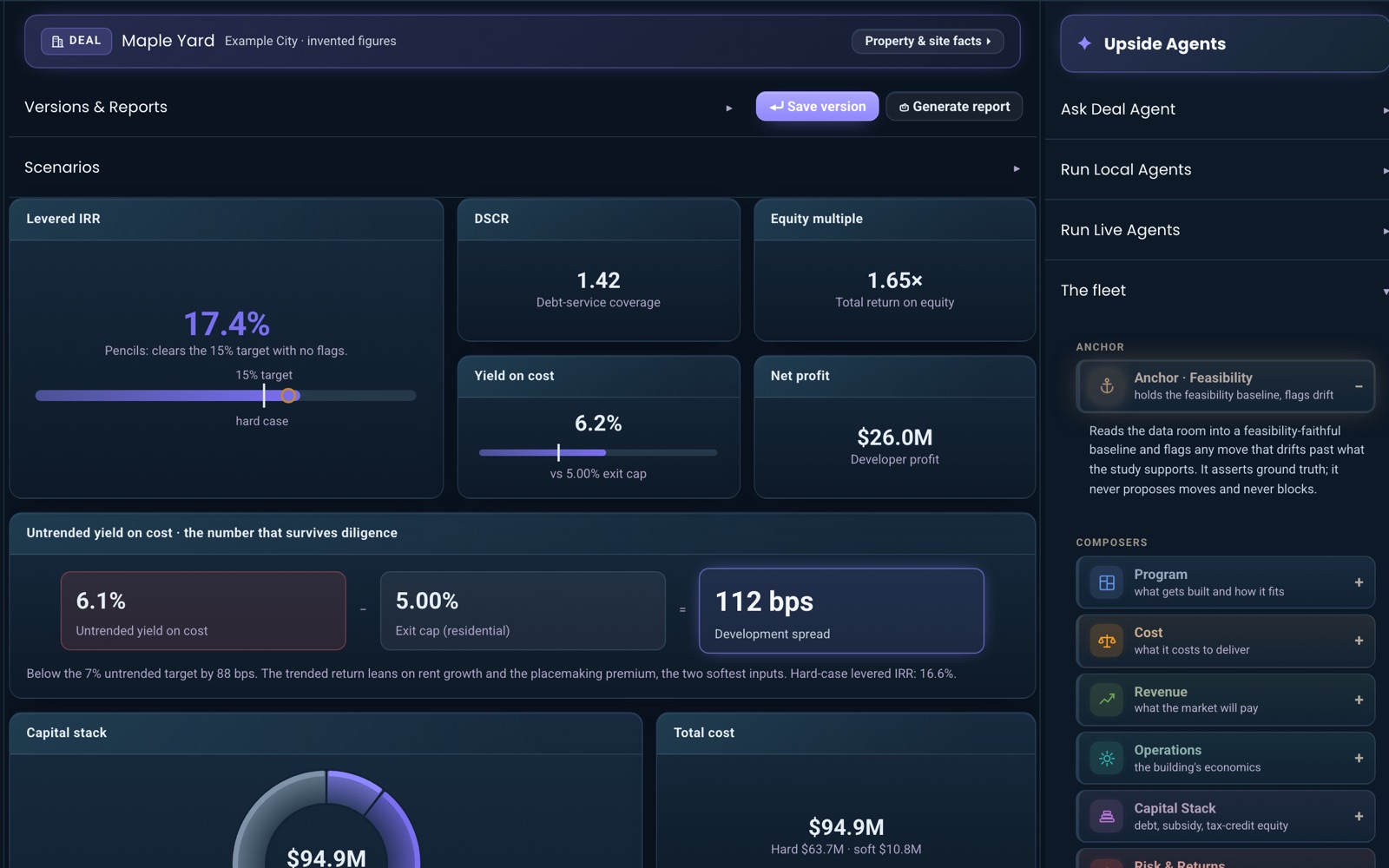
We buildOne live model your partners and a team of agents work at once. Agents propose sourced assumptions; a fixed model does every calculation.
The mathScenarios in minutes instead of meetings, and output that survives a lender's questions. Try it before you buy anything.
ProblemRestructuring debt and equity mid-negotiation means rebuilding the waterfall by hand, and errors surface at closing.
We buildDebt sizing, pref and promote waterfalls, and structure comparisons as live scenarios on a fixed calculation engine.
The mathOne waterfall error caught before closing pays for the build. Negotiating in real time is the bonus.
Standard · 4–8 wksfrom $15kOn demand
Green & impact capital prep
ProblemGreen bonds, sustainability-linked loans, and ESG-mandated equity want measured, framework-aligned data most sponsors can't produce.
We buildYour project data mapped into use-of-proceeds documentation and KPIs, on an established measurement platform we configure.
The mathBasis points on real debt dwarf documentation costs: 25bps on $20M is $50k a year.
Platform + docsfrom $10k + monthlyPlatform ready
Free your deal data
The unglamorous step everything else depends on.
Deal data extraction
ProblemRent rolls, leases, feasibility PDFs, old memos, the model in one person's Excel — trapped where neither your team nor your AI can use them. Practitioners name this as the reason AI hasn't helped their core work yet.
We buildExtraction into structured, validated data, every field linked back to its source page.
The mathThis is the multiplier: every other card on this page gets cheaper and better once it exists.
Standard · 4–8 wksfrom $15kOn demand
Lease abstraction & obligations
ProblemCritical dates, options, and escalations live in lease PDFs, and a missed notice window costs real money.
We buildLeases abstracted into a queryable table with alerts; every field links to the page it came from.
The mathOne missed renewal option or un-billed escalation typically exceeds the entire build cost. Abstraction services charge per lease forever; this is yours.
Light · 2–4 wksfrom $7.5kOn demand
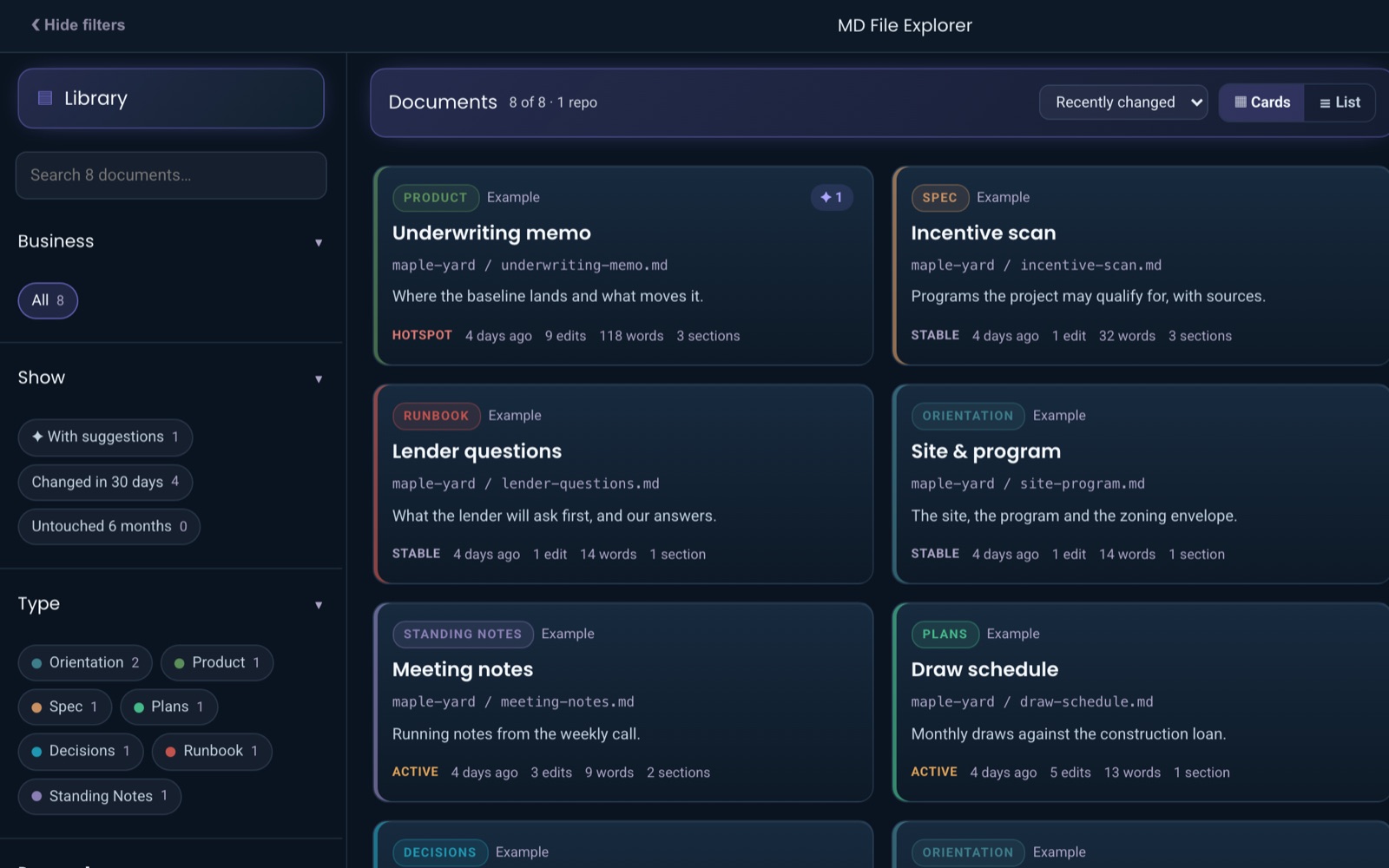
Institutional memory search
ProblemYour best precedents — old IC memos, partnership agreements, closed-deal post-mortems — are unsearchable, so new hires re-learn what the firm already paid to know.
We buildPrivate, permissioned search over your deal archive, with citations to the document.
The mathDiligence and onboarding hours, recovered — and it is the lowest-risk place to start with AI, because it cites instead of calculates.
Light · 2–4 wksfrom $7.5kOn demand
Lenders, IC & investors
Speed you can defend, for the audience that has to say yes.
Lender & IC packages
ProblemSources and uses, returns, debt, sensitivities: a week of assembly per iteration, and every resize starts it over.
We buildPackages assembled from the live model, with the provenance behind every assumption attached.
The mathDays per package, times every resize — and sourced assumptions clear committee with fewer cycles.
ProblemQuarterly letters, distribution notices, and tax season eat weeks of principal time, or a portal bills you monthly forever.
We buildReporting assembled from model and property data, letters drafted in your voice, portal-ready.
The mathInstitutional-feeling investor relations at sponsor scale — and investors who feel reported-to come back for the next raise.
Standard or operatedfrom $15kOn demand
Data room & diligence prep
ProblemEvery raise or refi rebuilds a data room by hand, and lender or investor Q&A eats principals' time.
We buildA data room assembled and maintained from your files, with drafted, sourced answers to diligence questions.
The mathDays shaved off every close, and carry costs make close speed directly monetary.
Light · 2–4 wksfrom $7.5kOn demand
Build & deliver
Where the money actually gets spent.
Construction cost first pass
ProblemReal estimates need a general contractor and weeks; early deals ride on stale dollars-per-foot folklore.
We buildBenchmarked assemblies plus your own cost history, producing a ranged early estimate tied to the program. It reshapes deals early; it does not replace a GC bid, and we'll say so.
The mathA dead deal discovered at GC pricing costs the whole pursuit budget. This moves that discovery months earlier.
Standard–Deepfrom $15kOn demand
Draw & pay-app review
ProblemMonthly draws mean chasing lien waivers and checking pay applications line by line.
We buildDraw package assembly, waiver tracking, and variance flags against budget and schedule of values.
The mathPublished cases in this category report draw processing falling from days to under an hour. Across a multi-project pipeline, that is a hire you don't make.
Standard · 4–8 wksfrom $15kOn demand
Vendor & procurement workflow
ProblemSourcing vetted subs and suppliers — especially for sustainable systems — is slow, and RFP-to-bid-leveling is manual.
We buildA curated vendor directory, RFP and bid automation, and tracking of who actually performed.
The mathBid-leveling hours per trade per project, plus the quiet cost of re-hiring vendors who underperformed last time.
Standard · 4–8 wksfrom $15kOn demand
Operate & report
Manage in-month, not in-arrears.
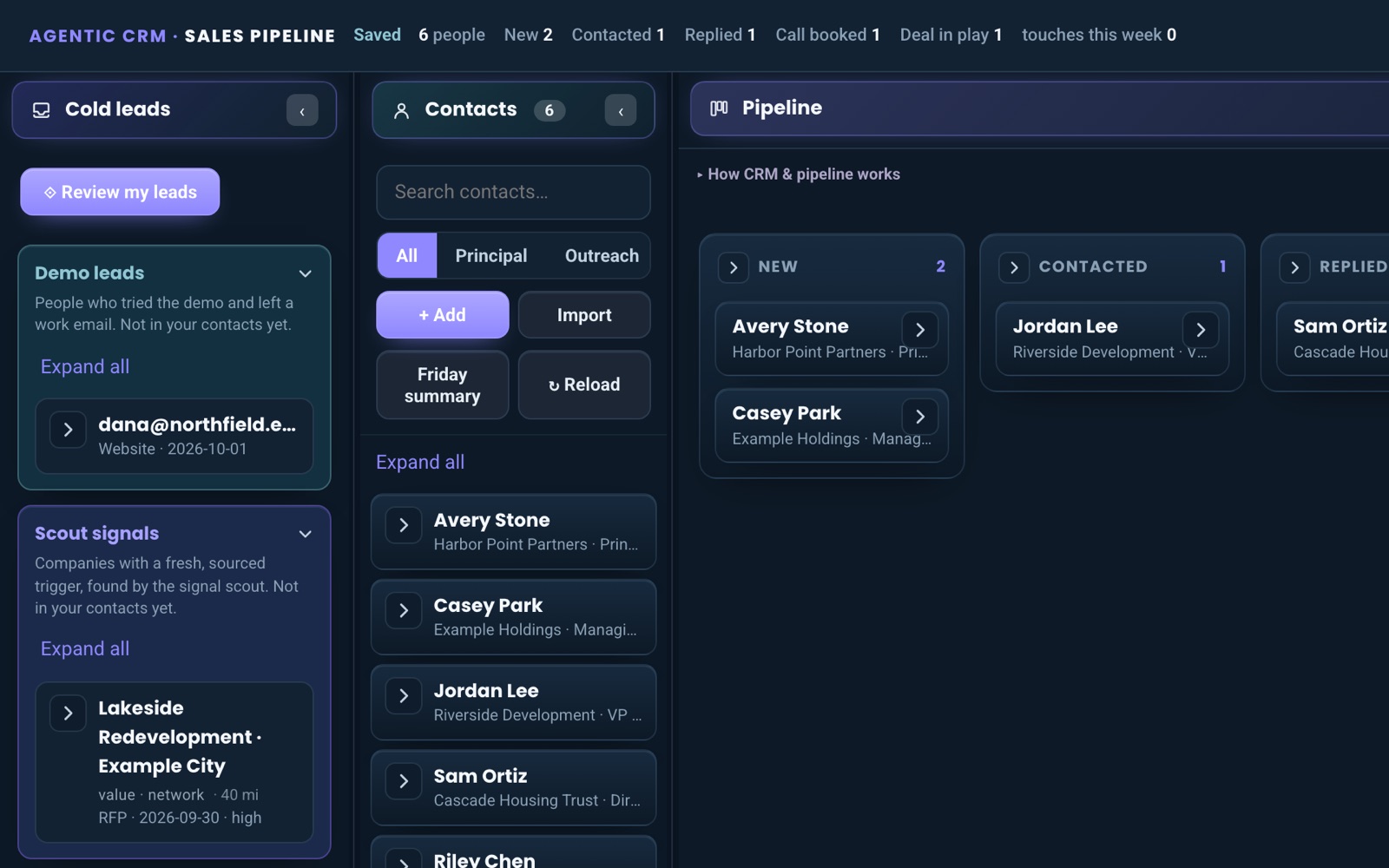
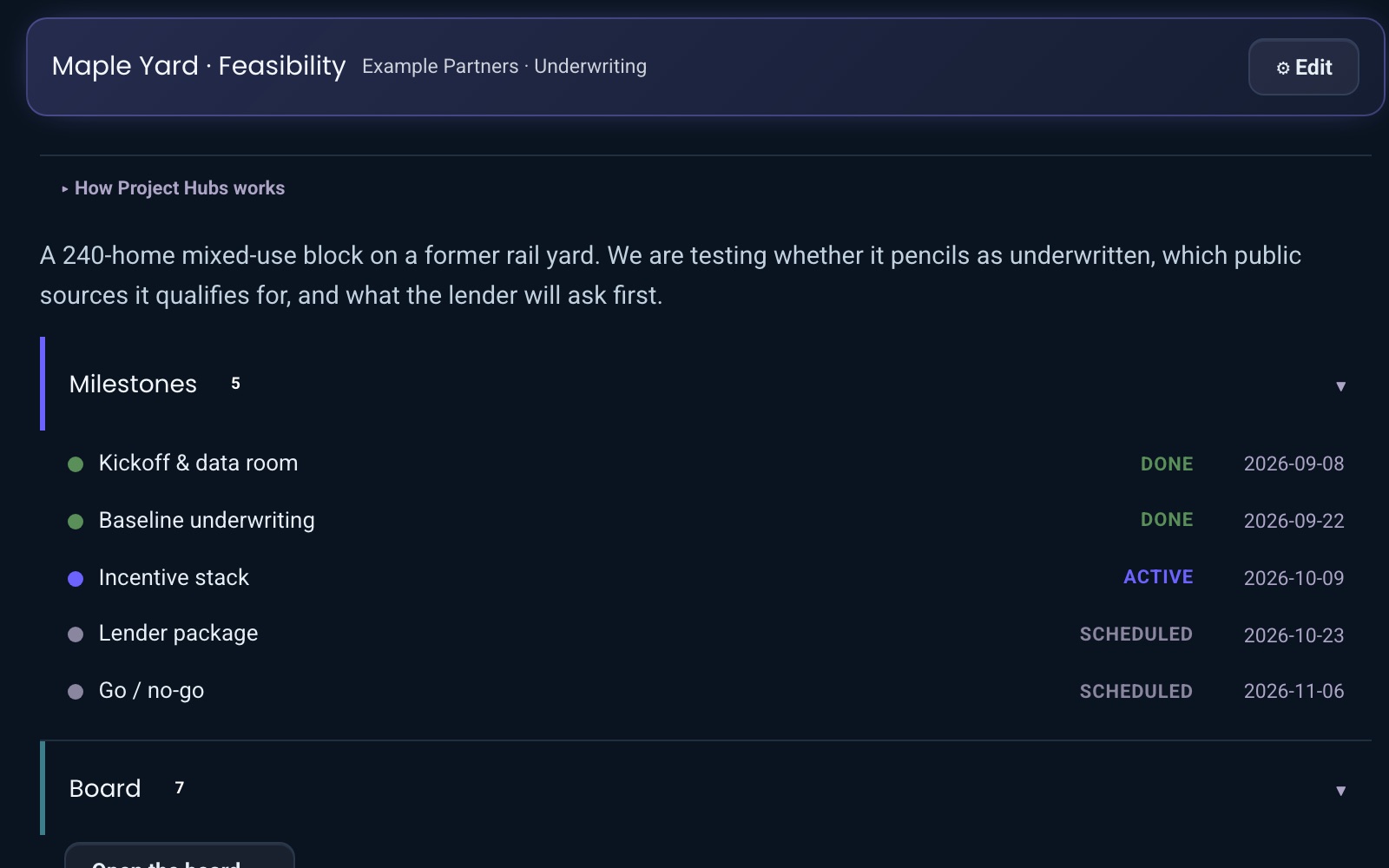
Pipeline watch & reporting
ProblemMonthly updates assembled from scattered threads and files, and a no-go silently becomes a go when the market moves and nobody re-runs the model.
We buildRecurring updates assembled automatically, and models that re-run on market triggers with alerts.
The mathOne resurrected deal, or one early warning, covers years of the retainer.
Standard + monthlyfrom $15kOn demand
Asset performance dashboard
ProblemNOI variance is discovered at quarter close, and utility and operations data live in separate systems.
We buildLive budget-versus-actual with utility anomaly detection and variance flags.
The mathA single caught utility anomaly or tax escalation error often covers the build; the compounding value is faster response.
Standard + monthlyfrom $15kOn demand
Building energy management
ProblemEnergy is the biggest controllable operating line, and most building systems run on installer defaults.
We buildSmart controls, monitoring, and optimization toward net-zero targets, configured on an established building-management platform.
The mathUtility savings against a monthly fee, measured — we structure it so the payback is visible in your bills, not our slides.
Measured, certified, and financeable — the full practice lives at Now City Circularity.
Emissions tracking & ESG reporting
ProblemLenders, investors, and cities increasingly ask for measured emissions and framework-aligned disclosure, and spreadsheet ESG doesn't survive an audit.
We buildMetered, real-time greenhouse-gas tracking with automated reporting and audit support, configured from an established platform.
The mathCompare one setup against annual consultant-built reports, re-bought every cycle — and it feeds the green-capital card above.
Platformfrom $10k + monthlyPlatform ready
Embodied carbon & certification
ProblemLEED, WELL, EDGE, and BREEAM certification and embodied-carbon analysis are consultant-heavy, slow, and re-bought per project.
We buildBaseline studies, multi-scenario lifecycle analysis, compliance reporting, and a live dashboard through certification.
The mathCertification as a managed pipeline instead of a bespoke scramble, and certified assets reach capital that uncertified ones can't.
Platform + servicesfrom $10k + per projectPlatform ready
Carbon credits from your project
ProblemProjects create real reductions — solar, reuse, transit-oriented design — but turning them into credits is opaque and intermediated.
We buildLifecycle management from measurement to certification to sale, on an established credit platform.
The mathA revenue line most sponsors leave on the table; the scope call sizes it honestly before you spend anything.
Platformfrom $10kPlatform ready
Resident & community engagement
ProblemCommunity opposition slows entitlements, and post-occupancy engagement is an email blast.
We buildResident portals, participatory tools for surveys and priorities, and community-investment dashboards.
The mathMonths of entitlement delay carry six-figure costs on any real project; demonstrated engagement is also increasingly a public-financing criterion.
Standard · 4–8 wksfrom $15kOn demand
District resource dashboard
ProblemMaster developers and districts run energy, water, waste, and mobility as separate silos with no shared picture.
We buildNeighborhood-scale monitoring and optimization across resource systems, phased from one building to the district.
The mathSized per district. The honest sequence: start with one building's energy management, extend when the data pays for itself.
Deep · phasedfrom $30k + monthlyPlatform ready
Something not on this list
ProblemYour bottleneck is specific to how your shop works, and no menu catches it.
We buildThese are patterns, not products. The first conversation is about what you're trying to accomplish and where the time actually goes; the build follows from that.
The mathA $2,500 working session that scopes it — credited toward the build if we do one.
Scoped togetherStart with a call
For finance and capital teams
The same accelerations, from the other side of the table.
Screen more inbound without more staff. Verify a sponsor's assumptions without rebuilding their model. Standardize how deals compare across a portfolio, and take every number to IC with its source attached. We can build it around how your fund actually works.
Twenty-six cards is a map, not a pitch. Nobody needs all of it, and the right first build is usually the smallest one that touches your biggest bottleneck. We can go deeper with your team on the tools, build the piece you're missing to your specifications, or run it with you. The Upside Explorer on this site was built for our own deals the same way, which is why we're comfortable letting you drive it. And if you'd rather learn to build this yourself, that's a real path too: see AI DIY education.
Which of these is your bottleneck?
Tell us what you're trying to get built and what's slowing it down. A short conversation is the fastest way to see if we can help.