A working example · Upside Explorer

Find more upside in a deal, together.

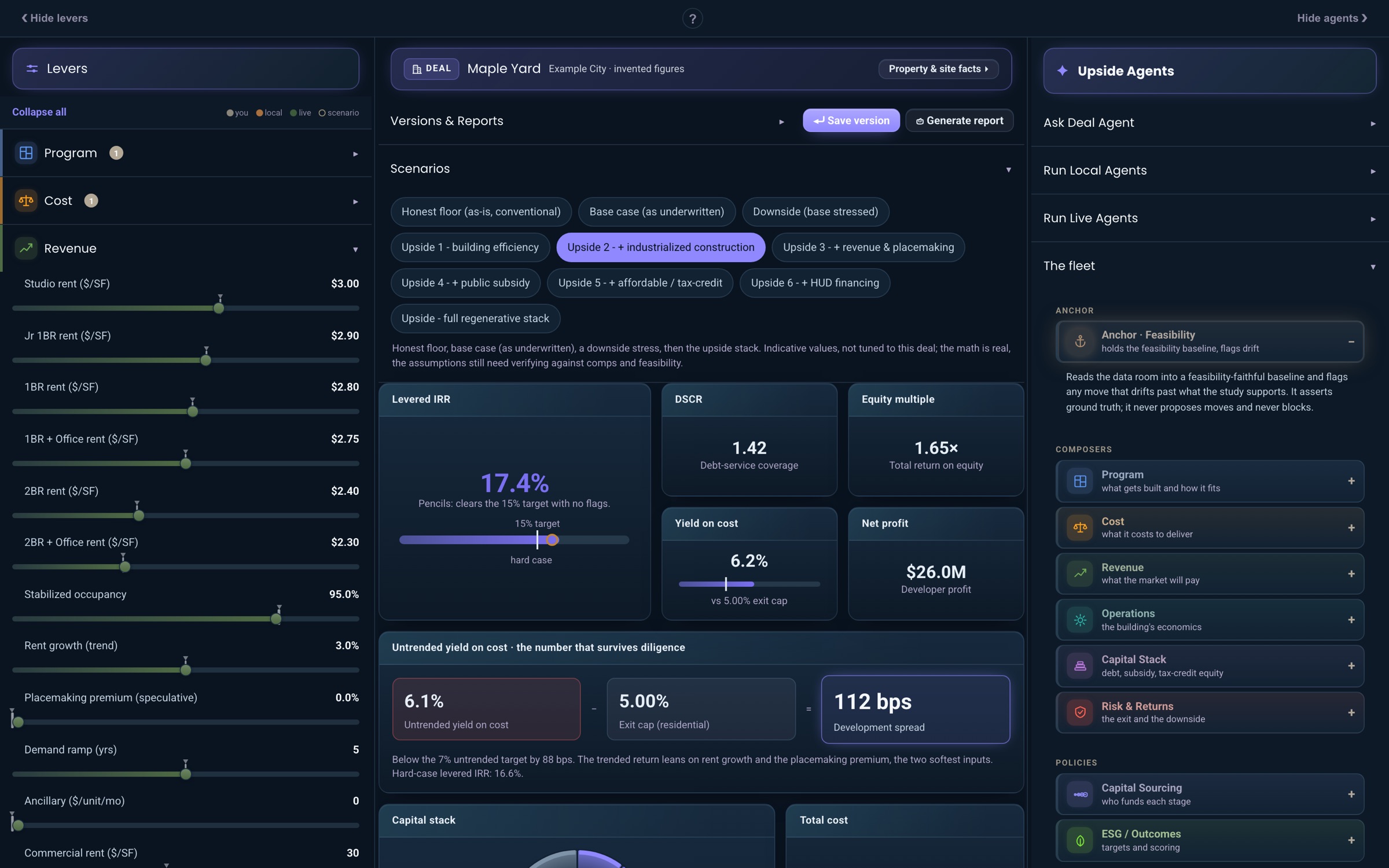
A live model the whole team can work at the same time. Move an assumption and the numbers move with you, with your partners and a team of focused agents on the same model. Every number traces to its source.

Try the live demo → Book a call
Your work email opens the demo. It runs in your browser.  ·  Meet the team
Riverside Crossing, Phase One Riverfront district · Multifamily + retail ● live model ASSUMPTIONS Hard cost / SF$291 Average rent$2,180/mo Exit cap rate5.25% Affordable share20% LIHTC equity$14.2M Construction rate7.8% RESULTS Levered IRR 18.4% from base 9.2% DSCR1.42 Equity multiple2.1× Net profit$31M How the value was built Base 9.2% + Revenue, Capital Stack + Cost, Risk & Returns → 18.4% AGENTS Revenue+2.1% Rent to market median, 8 comps Capital Stack+3.4% LIHTC + C-PACE, DSCR held Cost+1.8% Industrialized framing Anchorholds baseline Within feasibility bands ✓ This run ≈ $0.04 · 12.3k tokens
Interactive demo. Move a lever and watch the deal respond →
Built like the software your team already relies on
Vercelhosting
Next.jsapp
Clerkauth
Neondatabase
Cloudflareedge + files
Claudereasoning
Renderagents
Why it is here

Built for our own deals, shown as an example.

The Upside Explorer came out of our own development work, and it is the clearest example of what we do. Try it on a deal. Then, if it fits, we can go deeper on it with your team, shape it to your work, or build and operate a system to your specifications.

The problem

The upside is real. It is just hard to see.

Industry surveys say nine in ten real estate firms are piloting AI, and one in twenty got what they hoped for; the gap is trust in the numbers, not the models. On a complex deal the value hides in the gaps: siloed teams, a pro forma only one person can really drive, and dozens of moving variables that never get tested together. The Upside Explorer makes the whole model live and shared. Change any assumption and watch the deal respond, with your partners and a team of focused agents working the same numbers beside you, every move attributed, every input sourced.

How it stays honest

The math is fixed. The intelligence sits on top.

Two parts, kept apart on purpose. One underwriting model does every calculation, the same way every run. The agents only ever propose assumptions. So an agent can be wrong about a number without ever being wrong about the math, and nothing it does can quietly nudge the result.

The model

One model, the same every run

A fixed pro forma that runs the same calculations every time, tested number for number. Same inputs in, same numbers out. No agent can reach in and change it. This is the part you hand to a lender, with no guesswork and no surprises.

The agents

They propose. They never calculate.

A team of agents, each fluent in one part of the deal, propose moves and show their reasoning and their source. A dedicated Anchor holds the feasibility baseline and flags anything that drifts from it. The model does the math.

Eleven agents, each a distinct discipline:

Anchor · Feasibility ProgramCostRevenueOperationsCapital StackRisk & Returns Capital SourcingESGInsuranceEntitlements
How it works

From a baseline to a defensible underwriting, in three moves.

Start from the baseline

Begin with an honest base case, tied to the feasibility study and calibrated to real market comps, the program, the costs, the financing.

Drive it, or hand it over

Move the levers yourself and watch the numbers move with you. Or hand the deal to the agents and watch them find value, one sourced move at a time.

Get something you can defend

A full underwriting: sources and uses, returns, debt, and program. Behind every assumption sits its source, its confidence, and who put it there.

App Launcher →See a sample report

“An agent can be wrong about an assumption without ever being wrong about the arithmetic. That is the whole design.”

Why it is different

It builds the deal. It doesn't just grade one.

Acquisition tools lay a single AI reviewer over a deal you have already shaped. The Upside Explorer is a development tool, for finding the value that makes a ground-up project work and keep working, for everyone at the table.

A single AI reviewer

Grades an existing, stabilized asset
Critiques numbers you already entered
One generalist voice over the spreadsheet
Answers “should I buy this?”

A team that reveals the value

Finds the value that makes a ground-up project pencil
Shows who created which value, step by step
A team of agents and a lead, anchored to the study
Answers “what do we build, and how do we make it work?”
The bigger picture

Two ways a project fails. Both come down to assumptions.

A project can fail because it never pencils. It can also fail a slower way: it gets built, then delivers a place people and the surrounding community did not really need. The first is a financial-assumption problem. The second is an outcomes-assumption problem. Now City is building an engine for each.

Upside Explorerlive

The financial assumptions engine, and the working example you are looking at. It finds the value that makes a project pencil and hold up, with the source behind every number.

Outcomes ExplorerIn development

The outcomes assumptions engine, and the twin we are building next. It clarifies what a place actually needs, then aligns the upside work here with those outcomes. Read the early thinking →

Bring your next deal to life.

Try it on a deal you know, or book a walkthrough. Then tell us what your team needs: we can go deeper with your team, build to your spec, or drive it with you.